
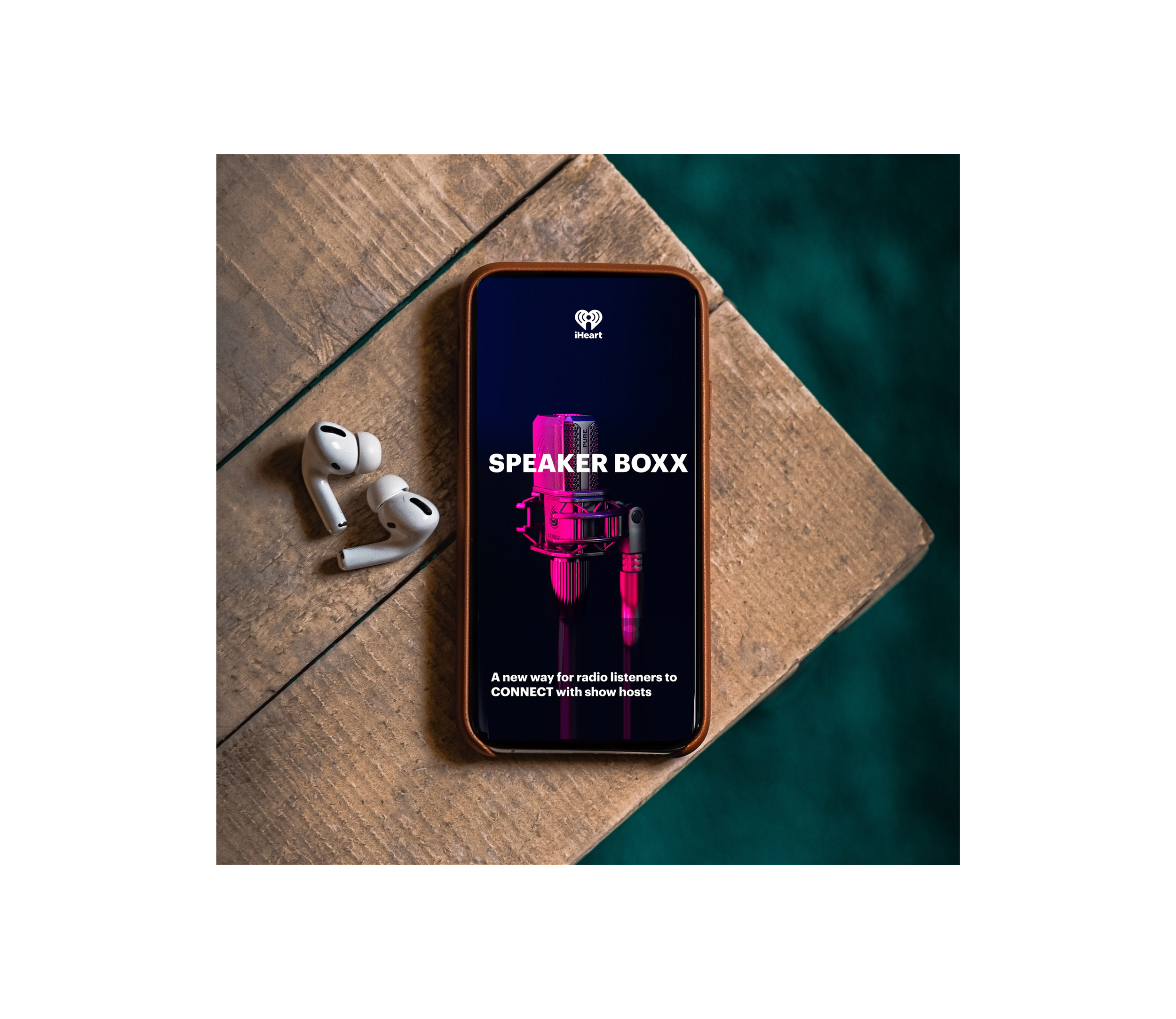
Speaker Boxx: Live Radio Reimagined
iHeartMedia · 2 Live Crew
Overview
Transforming live radio from passive listening into active participation
Speaker Boxx explored how interactive experiences could transform live radio from passive listening into active participation. Designed, prototyped, and presented in one week during iHeart Hackweek, the concept introduced real-time engagement tools directly into the iHeartRadio listening experience, allowing radio hosts to interact with audiences through polls, Q&A, song requests, and moderated call-ins.
Our team presented a working prototype to iHeart leadership and was awarded the Hackweek Grand Prize.

The Opportunity
Live radio had scale, but not participation
While platforms like Clubhouse and Twitter Spaces normalized interactive audio experiences, radio streaming remained largely one-directional. iHeartRadio already reached millions of digital listeners each month, but hosts had limited tools to engage with audiences in real time beyond traditional call-ins.
At the same time, listener behavior was shifting. Audiences wanted lightweight participation, social audio adoption was accelerating, and users were increasingly comfortable engaging without video.
Constraints
Because this was a Hackweek initiative, the project had significant constraints: a 1-week timeline from concept to presentation, limited engineering bandwidth, no existing infrastructure for live audience participation, and a prototype realistic enough for a live executive demo. The challenge was not designing every possible feature. It was identifying the smallest viable interaction model that could demonstrate meaningful audience engagement.
Product Vision
Augmenting radio, not replacing it
Rather than recreating a standalone social audio platform, we focused on augmenting existing radio behavior with lightweight interaction layers. The goal was to preserve the simplicity of live listening while giving hosts new ways to activate their audience in real time.
We defined three core principles early on:
Lightweight Participation
Interactions needed to feel fast, intuitive, and secondary to listening.
Dual-Sided Experience
Both hosts and listeners required purpose-built workflows with different needs and priorities.
Familiar Radio Behavior
The experience needed to feel additive to radio, not a replacement for another social platform.
The Experience
Two connected surfaces: one for listeners and one for hosts
As the sole designer on the team, I handled the entire design process, from flow mapping to final prototype, which our engineer then built upon for the live demo. Speaker Boxx was designed with two distinct surfaces: the listener-facing app experience and a host-facing control interface.
Listener-Facing
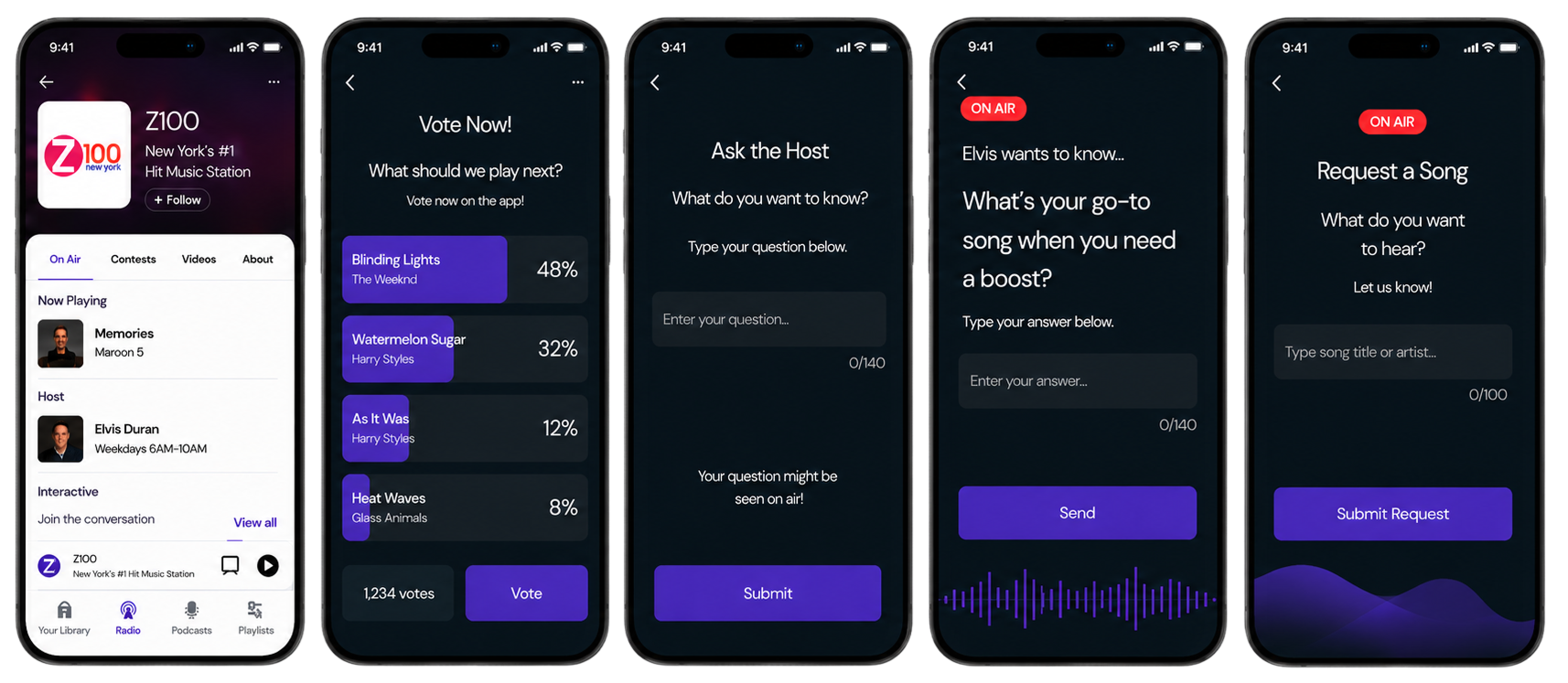
- Live Radio Profile redesign
- Host opened a poll
- Host is accepting questions
- Host asked a question
- Song request feature
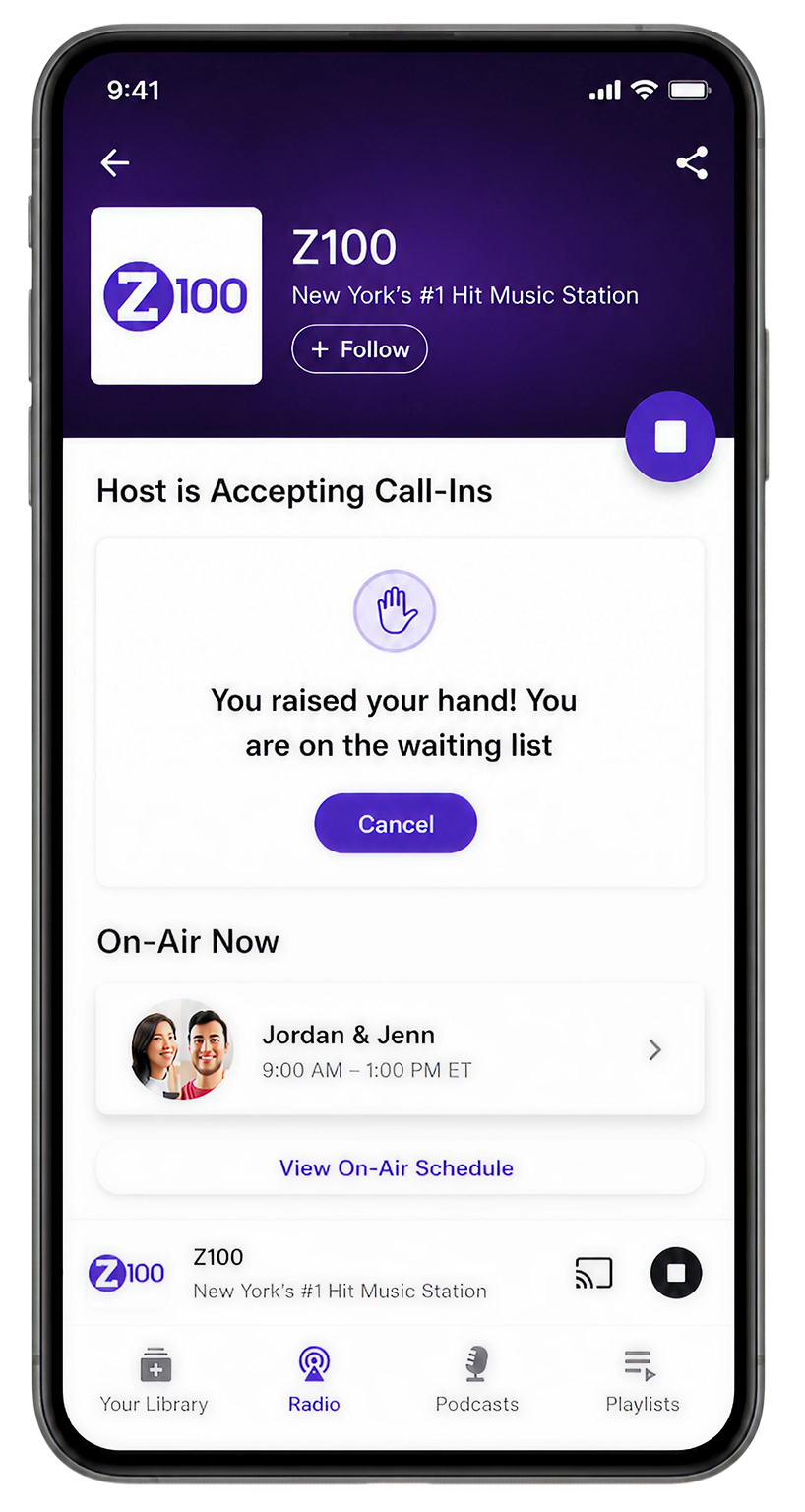
- Raise hand for call-in
- Push notifications and lock screen
Host-Facing
- Create and launch live session
- Open polls, Q&A, song requests, call-ins
- Live poll results
- Question queue with viewer details
- Ranked song request list
- Pending call-in management
- Real-time engagement analytics
Designing for live moderation
One of the biggest product challenges was balancing audience participation with broadcast safety. We explored open participation, automated listener queueing, and moderated host approval workflows. We ultimately prioritized a moderated queue system that allowed hosts to screen and approve participants before bringing them live on air. This reduced operational risk while aligning more closely with existing radio production behavior.
The Outcome
Grand Prize, iHeart Hackweek
After one week of designing, building, and iterating, our team presented a working demo of Speaker Boxx to iHeart leadership. We were awarded the Grand Prize at iHeart Hackweek.
Beyond the award, the project demonstrated how existing radio audiences could become active participants through lightweight interaction models layered onto live broadcasting.

Success metrics we defined
- Listener participation rate
- Poll completion rate
- Session engagement duration
- Repeat participation frequency
- Host adoption and usage frequency
- Listener retention during interactive moments
Future opportunities
- Expanded creator tooling Additional moderation and audience management capabilities for hosts running complex live sessions.
- Asynchronous participation Allow listeners to contribute audio clips and questions outside of live sessions.
- Automotive experiences Adapt interaction patterns for OEM and in-vehicle listening environments.
- Audience education Introduce onboarding patterns that help listeners understand interactive radio behaviors.